Design Systems · Agents
You too need a design factory
Product teams call it a design system. Ramp's brand team calls it brand as infrastructure. Growth teams call it a marketing factory. Engineers call it a software factory. The value is becoming clear, and it is tremendous.
Contents
Last week I watched Paul Jun’s talk on Dive Club and read his two essays, Brand as Software and Brand as Infrastructure. I got excited, because he is bringing visibility to the exact thing I focus on these days, and I have built it three times.
The talk’s title names the goal:
Michelin star vending machine
How do you take the team who has the taste and craft, the decisions that they make, and turn those decisions into repeatable work using software? That’s where the Michelin star vending machine comes in.
Paul Jun, brand and AI systems at Ramp
At Ramp, anyone types a request into Slack and gets an excellent, on-brand asset back. An agent picks a skill for decks, documents, graphics or landing pages, pulls facts from Notion, Snowflake and Gong, and renders the asset. Automated tests check for broken dimensions, missing fonts and overflowing copy, and send failures back to be fixed. Before any request arrives, designers make and approve “10/10” examples in Figma, so the agent has excellent work to imitate. When a request has no template, the agent still makes an attempt and logs the gap. A designer then turns the attempt into new 10/10 examples within a day or two.
About 200 people at Ramp use the system every week, and one marketer produced and localized more than 80% of the assets for the UK launch alone. The brand team’s goal is a brand that is “easy to love and impossible to misuse”, and the automated tests are the part that makes misuse impossible.
Paul expects most of a company’s marketing work to go this way:
80 to 90%
I truly believe 80 to 90% of [a company’s marketing assets] can be fully automated away. And what I mean by automated is that it’s not like fast food. It’s not like, oh, it’s just good enough.
Paul Jun, brand and AI systems at Ramp
A design factory is one kind of factory
Engineers call this kind of system a factory. A software factory is a system of agents that takes a task, writes the code, tests it and ships it, inside rules and acceptance criteria that people set. The tests sit outside the agents’ control, so an agent cannot approve its own work. Mistakes that repeat become new instructions or new tests. I call the version that produces design a design factory, whether it produces a brand system like Ramp’s, product UI or copy.
Teams in many fields are building a factory right now, and each team gives it a different name.
- Product teams build design systems for UI. Tokens, components and contracts that coding agents follow, so generated screens match the product.
- Brand teams build systems like Ramp’s, where anyone asks an agent in Slack for a deck or a landing page and gets one that follows the brand.
- Growth teams build marketing factories. Agents write ad scripts, render videos and posts, publish them and feed the results back into the next batch.
- Engineering teams build software factories. Agents write code, run the tests, run linters and type checks, and fix what fails before a person reviews it.
- Hardware and civil engineering teams build the same thing for CAD. A machine part or a house has components and rules too: standard parts, tolerances, building codes, load limits. An agent that draws plans for a house or a device has to follow all of them, so somebody has to write them down first.
- Analytics tools such as PostHog are moving the same way. Agents read session recordings, error reports and usage data, fix what is broken and suggest what to change next.
The last one is close to the generative UI work I do. A product that reads its own usage data and proposes changes to its interface is a factory where the output is the product itself.
This post brings together three kinds of work I have been doing separately. I build design systems for agents. I build multi-agent systems on the BEAM and observe them while they run. I build generative UI. A design factory is where those three meet.
What a design factory is for
The goal of a design factory is that anyone in the company can produce work that stays on brand without asking a human designer for help every time. A salesperson makes a deck for tomorrow’s call. A marketer adapts a launch page for a new country. An engineer builds a settings screen that matches the rest of the product. None of them waits for the design team, and design stops being the bottleneck for every asset the company needs.
The design team wins as much as everyone else. Everything that follows a rule is automated, and designers spend their time on what they are best at: creative work, new ideas, strategy and concepts nobody has thought through yet.
Finance used to split its work into two parts, compliance and consulting. Compliance was the paperwork: filing reports, meeting every legal requirement, paying taxes and duties on time. Consulting needed deep analysis and systems thinking, and firms put their best people on it. A design factory takes over the compliance part of design, so designers can do the consulting part.
Most companies already have the raw material
Almost every company already has the raw material for one. It has brand guidelines, maybe a component library, some templates and a folder of past work. A factory puts all of it into one coherent system. The system keeps track of every rule and follows it. It also collects the rules nobody wrote down along the way: rules that live in one person’s head, and rules too ambiguous to follow until someone clarifies them. Finally, the system changes as the company changes. A rigid rulebook stops a team from trying new things. In a factory, new work adds new rules.
A component library is a relatively small part of this. Components implement higher-level decisions: the brand strategy, the product strategy, the design direction. The same decisions set how decks are laid out, how long a pull quote can be, what tone the copy has, which words the company never uses and what a launch has to include. A design factory has to work at that higher level, one or two levels above the components. From there it can produce a component library itself.
Take a company that launches a sub-brand for a different audience or a slightly different product. The sub-brand needs its own style, related to the main brand and distinct from it. A good design factory can outline a direction for the sub-brand from the main brand’s strategy and from what makes the new product different. The new component library is one output of that direction, next to the decks, the copy and the launch assets. Anything that follows a rule can be produced by an agent and checked by software.
What makes a design factory
In simplest terms, these are the core parts of every design factory.
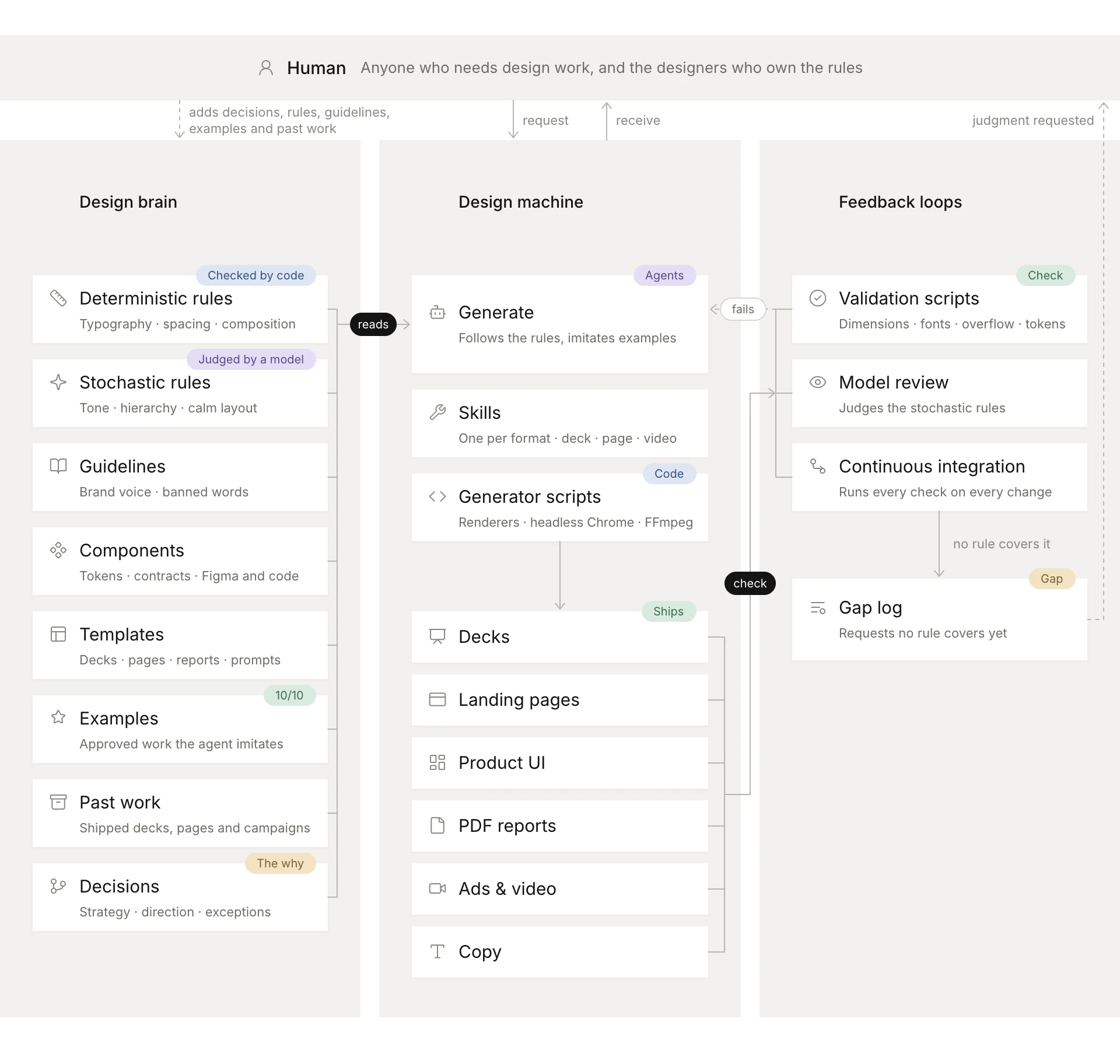
- Rules and examples. The decisions that used to live in people’s heads, written so an agent can read them. Some are hard rules, such as “a pull quote has at most 175 characters”. Some are approved examples that show what good output looks like.
- An agent that produces. It turns a request into an output by following the rules and imitating the examples. The output can be a deck, a PDF report, a TikTok video or a React component, and the request can come from Slack, a terminal or a dashboard.
- A check. Every output is checked against the rules before it ships, and failures go back to the agent to fix. Some rules are easy to test with code: is the card inside a panel, is the quote under 175 characters, is there an em dash. Others need judgment. Checking “keep the layout calm” means one model judging another model’s output, so rules like that start as advice and become hard checks once someone finds a way to test them. Software has the same gap. Dex Horthy points out that tests confirm the code works, and nothing in them measures whether the codebase stays easy to change.
- A loop that adds rules. Every request the rules do not cover means a rule is missing, unclear or kept in one person’s head. The system records it, a person decides the right answer, and the decision becomes a new rule or a new example.
The loop makes it a factory. Without it the system only generates content, and the rules never change after the day it was built. With it the system covers more cases every week. Ramp’s system has all of these parts: skills and 10/10 examples, the agent, the automated tests and the gap log. A design factory moves design judgment to the start. Designers decide what good looks like once, in rules and examples, instead of reviewing every asset at the end.
A factory also knows when to act on its own and when to bring in a person. A system that learns new rules can also learn wrong ones, so a person approves every new rule. Most requests need nobody. Requests the rules do not cover, and requests where a wrong answer costs a lot, go to a person. Support and finance teams need a person more often. A support team has rules about tone, refunds and when to escalate, and a finance team has rules about which spend needs approval. “Escalate an angry enterprise customer” or “flag unusual spend” is harder to verify than a quote length, and a wrong answer costs more. In those teams the rules start as advice and become hard checks one at a time.
I have built one for product UI, marketing and job applications
At Enaia I built an agentic design system for the product UI. Every component has a contract: purpose, anatomy, slots, accessibility, decisions. Rules carry a severity, so some are hard errors and some are advice. An edit-time hook stops a coding agent from writing code that breaks an error-level rule. One command checks the Figma library, the React components and the Phoenix components against the same contract. I wrote about it in three parts. The same system also rendered PDF reports from the same rules.
At Enaia the loop started with an evaluation harness. The harness recorded that generated cards sat on a white page in 12 of 14 runs, while in the real product cards sit inside a gray panel. No rule covered card placement yet. The evidence for the missing rule was in the log before I wrote the rule.
For Boocheck, my meal-photo calorie tracker, I built the first version of a marketing factory. It mines complaints from Reddit and App Store reviews into a bank of angles and hooks. Claude or Codex writes ad scripts from those angles. The simulator records real app footage, headless Chrome renders the text cards and FFmpeg assembles the video. I review the candidates and approve a few. I do not run it every day yet, and I post to TikTok by hand because TikTok requires that. The loop is the part still missing. On Meta or Google ads the factory could read each ad’s results through the API and write them back into the angle bank, so the next batch starts from what worked.
For my job applications I use a smaller version of the same thing. I tailor my CV to each role, and every version comes from one Typst template with fixed styling. My writing rules sit in a voice profile: American spelling, no em dashes, no semicolons, banned phrases, how I use bold. Every CV is checked against those rules before it becomes a PDF. When a draft breaks a rule I had not written down yet, the rule goes into the profile and every later CV follows it.
Three domains, three output formats, three sets of rules. Components appear in only one of them. All three have the same core parts, and only the Boocheck factory still lacks the loop.
A design factory is a product, and it needs engineering
A design factory is easy to start. Write a few skills for an agent, add some examples, and the first outputs look good. Keeping it working is a different job. The rules need a format that both people and agents can read. The checks need code. The renderers need code. The loop needs storage, a review queue and a way to approve a rule without breaking the rules that already exist. Every new base model changes how the agent reads the rules, so the factory needs its own evaluation.
Paul says the same about Ramp. A brand team that wants this needs engineers, and it has to treat the system “not as a tool that you vibe code, but as a product” that gets better over time. Paul now has a backend engineer and a dedicated designer working on it.
So building a design factory takes three kinds of work at once. Design judgment decides what good output is and writes the rules and examples. Systems thinking decides how the rules relate, which ones are hard checks and how a gap becomes a rule. Engineering builds the checks, the renderers and the loop, and keeps them running. Most teams have people for one or two of these. The factory needs all three on one team.
A company’s own data works better as context than as training data
A designer often cannot fully explain why one layout is a 10 and another is a 7. A large language model learns relations between words that nobody wrote down, from huge amounts of text. Could a company train a model on its own design work and skip writing rules?
For most companies, not yet. Fine-tuning a model needs hundreds and preferably thousands of reviewed examples, with variety and with near misses that look right but are wrong. A company with 30 good assets would get a model that copies those 30 assets. Putting the best examples into the agent’s context with each request works better at that size, and it still works after the next base model release. A fine-tuned model has to be trained again.
A design factory still produces that training data. Every approval, rejection and comment the loop records is a reviewed training example. A company that runs a design factory for a year has the dataset to train its own design model. A company without one has nothing to train on.
Time for the work no rule describes
Once a factory takes over the compliance part of design, designers get their time back for the consulting part: a new direction, a new idea, the first version of something the company has never made.
I am building my fourth design factory now, for a client. If you want one for your company, email me.